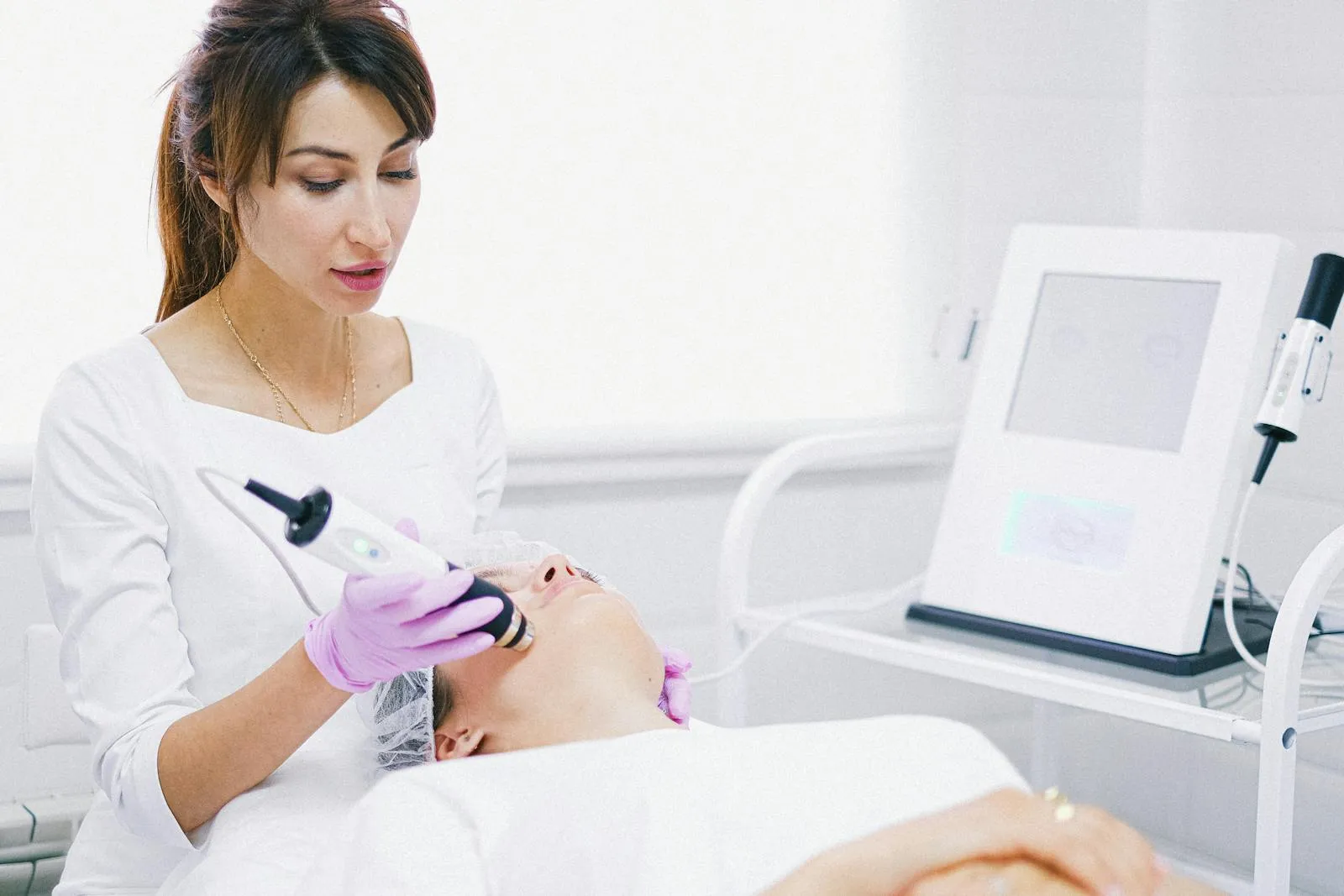
Ask ten people what a facial is and you will get ten different answers. A relaxing mask and a hot towel. A blackhead extraction that leaves you red for a day. A 45-minute spa ritual before a flight. All of these exist, and none of them are wrong — but they are not what we mean by a professional facial. The difference is not just in quality. It is in what the treatment is actually doing to your skin, at what depth, and through which mechanisms.
The Problem With the Word "Facial"
The term covers a vast range of services. At one end: a warm cloth, some cleanser, a hydrating mask, a light massage. Pleasant. Non-invasive. Zero downtime. At the other end: a multi-technology treatment that works across every layer of the skin — mechanical exfoliation, ultrasonic infusion, radiofrequency collagen stimulation, oxygen injection, electrical muscle activation, thermal cycling.
Both are called facials. The pricing gap between them — often several hundred percent — reflects not a markup but a genuine difference in what is happening to your skin.
This article walks through the technologies used in a clinical-grade facial: what each one does, how it works, and what it means for your skin. If you are deciding whether a professional facial is worth it, or trying to understand what distinguishes one treatment from another, this is what to know.
The Technologies, Explained
Hydradermabrasion (Bubble Cleaning)
Traditional dermabrasion uses a rough surface or crystal spray to physically abrade dead skin cells from the surface. Hydradermabrasion does something more sophisticated: it combines mechanical exfoliation with simultaneous deep cleansing, hydration, and serum infusion — all in a single pass.
A specialized handpiece creates a vortex of water, exfoliating agents, and active ingredients. Dead cells and debris are loosened and suctioned away while a hydrating serum is infused into the freshly cleared skin. Antioxidants are delivered at the same time, protecting the skin against oxidative stress as the surface layer is renewed.
What this means for your skin: Pores are genuinely cleared — not just surface-cleaned. Skin texture smooths immediately. Because hydration is delivered as the barrier is opened rather than after it has closed, absorption is significantly higher than with topical application alone.
Ultrasonic Vibrating Blade
This tool operates at 28,000 Hz — 28,000 vibrations per second. At this frequency, an ultrasonic blade performs two simultaneous functions: it dislodges dead skin cells, sebum, and surface debris through microscopic oscillation, and it temporarily disrupts the outermost layer of skin (the stratum corneum) to allow serum and active ingredients to penetrate much deeper than they can on their own.
The stratum corneum is one of the body's most effective barriers. It keeps moisture in — but it also keeps most topically applied actives out. The vibrating blade creates a transient window through this barrier, driving ingredients into the viable epidermis where they can actually function.
What this means for your skin: Cleaner, smoother surface. And far greater efficacy from whatever serum is applied — not because the formula changed, but because it can now reach layers where it does something.
Ultrasound
Medical ultrasound operates on the same physical principle as diagnostic imaging: sound waves transmitted through tissue. In aesthetic application, focused sound wave energy is directed at the deeper layers of the skin, where it generates controlled heat through molecular friction.
At the dermal level, this heat causes immediate collagen fibre contraction — which produces a tightening effect — and initiates a longer-term healing response in which the body produces new collagen to replace what has been thermally stimulated. The process is gradual; results from ultrasound treatments continue to develop over weeks as the collagen remodelling cycle progresses.
What this means for your skin: Firmer, more structured skin over time. Particularly effective for early laxity — skin that has lost tension but is not yet at a stage where more invasive interventions are warranted.
Bipolar Radiofrequency
Radiofrequency in aesthetic treatment uses electromagnetic energy to generate precise, controlled heat within targeted tissue. Bipolar RF delivers this energy between two poles, concentrating the field at a specific depth and minimising dispersion to surrounding tissue.
At six million vibrations per second, the RF energy creates molecular friction in the dermis. This friction raises tissue temperature enough to denature collagen fibres — causing them to contract and tighten immediately — while also activating fibroblasts, the cells responsible for producing new collagen and elastin. Simultaneously, the warmth improves the penetration of any serums being applied, driving actives deeper into the tissue.
What this means for your skin: Immediate visible tightening from collagen contraction. Ongoing improvement over four to six weeks as new collagen forms. Skin becomes progressively firmer and more even in texture with a series of treatments.
If you are already familiar with RF body treatments — which operate on the same principle at larger scale — the mechanism is identical. See our guide to radiofrequency body treatments for a deeper explanation of collagen physiology.
Microelectric Stimulation
The face contains more than 40 muscles. These muscles shape facial contours — but unlike the muscles of the body, they attach directly to skin rather than to bone, which means their tone directly affects how the face looks. Microelectric stimulation uses low-level electrical impulses, calibrated to the face's natural bioelectrical frequency, to trigger controlled muscle contractions.
This does two things. First, the contractions themselves strengthen and re-educate facial muscles — improving definition and reducing the appearance of sagging over time. Second, the electrical current stimulates ATP (adenosine triphosphate) production within cells. ATP is the cell's energy currency. More ATP means more cellular activity: better circulation, faster cell turnover, and — critically — more collagen and elastin production.
What this means for your skin: Lifted, more defined contours over a course of treatments. Improved cellular energy that supports all the other regenerative processes the facial is triggering.
Oxygen Bubble and Oxygen Injection
Cellular metabolism — everything your skin cells do — is oxygen-dependent. Two technologies in the suite address oxygenation from different angles.
Oxygen Bubble combines oxygenated water with active ingredients in a pressurised stream. It cleanses, removes dead cells, nourishes, and delivers oxygen to the surface layers of the skin simultaneously. The physical action is gentle; the biochemical effect is cumulative.
Oxygen Injection takes this further: high-pressure oxygen-infused fluid is driven into deeper skin layers, delivering oxygen and active serums past the epidermal barrier. At the cellular level, increased oxygen availability directly boosts mitochondrial function — more energy for repair, regeneration, and collagen production.
What this means for your skin: More metabolically active cells. Better circulation. A brightness that reflects actual cellular oxygenation rather than surface hydration alone. Particularly effective for dull, fatigued skin — the cumulative effect of Bali's UV, humidity, and environmental exposure.
Hot and Cold Thermal Cycling
The final technology is the oldest principle in the suite — and one of the most physiologically interesting. Heat and cold are applied in sequence to trigger a controlled vascular response.
Heat dilates capillaries and increases blood flow to the skin, opening pores and improving the delivery of nutrients and oxygen to tissue. Cold causes vasoconstriction — capillaries contract, pores tighten, and the inflammatory response is damped. The rapid alternation between these two states — thermal cycling — creates a pumping effect in the microcirculation that significantly increases collagen synthesis, reduces redness, minimises visible pore size, and addresses under-eye dark circles caused by vascular pooling.
What this means for your skin: Visibly tighter pores after treatment. Reduced redness. Improved skin tone and clarity. And — with repeated sessions — a measurable increase in collagen density as the vascular stimulation sustains a regenerative environment.
Why These Technologies Are Used Together
Each technology in the suite operates on a different mechanism and at a different depth. Hydradermabrasion clears the surface. The vibrating blade opens the barrier and drives actives into the upper dermis. Ultrasound and bipolar RF generate heat at the structural level for collagen remodelling. Microelectric stimulation addresses the muscular framework beneath. Oxygen infusion supports cellular metabolism throughout. Thermal cycling optimises circulation and locks in the work.
No single technology does all of this. The value of a multi-technology protocol is that it addresses every layer simultaneously rather than routing everything through a single mechanism and hoping for comprehensive results.
This is also why a professional facial requires trained hands and a calibrated machine — not just a product range and a skincare routine. The active ingredients in your serum cannot reach the dermis on their own. The RF energy has to be calibrated to your skin's depth and condition. The electrical impulses need to be set to frequency and intensity appropriate to your muscle tone. Get these wrong and the treatment is either ineffective or counterproductive.
How This Compares to a Typical Bali Spa Facial
A traditional spa facial is not without value. It provides relaxation. It cleanses the surface. A skilled aesthetician's manual technique — good pressure work, lymphatic drainage, a targeted mask — can address surface texture and leave skin looking noticeably better. The experience itself has genuine benefit.
But it is working with different tools on a different scope. A spa facial operates almost entirely at the epidermal surface. It cannot drive actives into the dermis. It cannot stimulate fibroblasts. It cannot cause the collagen remodelling that comes from controlled heat in the tissue. It cannot address muscle tone or cellular oxygenation at depth.
That is not a criticism — it is simply an accurate description of what the two services are. If you want an hour of calm and a fresh face, a traditional facial delivers that well. If you want to address the underlying causes of skin ageing, uneven tone, laxity, and congestion — the mechanisms that topical skincare alone cannot reach — a multi-technology treatment is what those concerns require.
For anyone spending time in Bali's climate — the UV exposure, humidity, and environmental load described in our skincare guide for life in Bali — the cumulative impact on the skin's structure goes beyond what surface-level care can fully reverse. Clinical-grade technology exists to address exactly that.
For a broader view of how facial treatments fit into a complete beauty picture, see our complete Bali beauty guide and our guide to choosing a beauty salon in Bali.
A Note on Sessions and Results
A single professional facial produces visible results — immediately after treatment and over the days that follow as the stimulated processes continue. But the more significant changes — structural collagen remodelling, improved skin elasticity, sustained clarity — develop over a course of treatments aligned with the skin's natural renewal cycle.
The skin renews itself roughly every 28 days. A course of four to six sessions, spaced two to three weeks apart, allows each treatment to build on the previous one. Maintenance thereafter — typically every four to six weeks — sustains the results rather than letting the skin return to baseline between interventions.
For specific concerns like post-sun hyperpigmentation or significant laxity, an initial intensive phase of weekly or bi-weekly treatments may be recommended before transitioning to maintenance. Your skin, assessed properly at consultation, determines the protocol — not a generic schedule.
Rose Petal is a beauty center on Jalan Labuansait in Uluwatu offering professional facials and skincare treatments daily from 10 AM to 7 PM — with a lounge bar, sunset terrace, and co-working space. To book your appointment, visit rosepetalbali.com or message us on WhatsApp.
Beauty, refined.